
If you have oily skin, you probably know the routine for the Best Face Wash for Oily Skin.
In the morning you wash your face and feel fresh for a while.
However, a few hours later your forehead starts shining.
Your nose looks greasy, makeup doesn’t sit, and by day’s end you may need Best Face Wash for Oily Skin.
However, the frustrating part is that you try a stronger cleanser.
At first, it feels satisfying. Additionally, your skin feels extremely clean—almost squeaky. However, soon it feels tight or dry, and somehow the oiliness comes back again.
So you try another face wash, the Best Face Wash for Oily Skin.
Additionally, another example follows.
If this sounds familiar, the problem isn’t that you haven’t found a strong enough face wash.
For oily skin, you may choose cleansers by how dry and clean they feel.
Instead, consider how well they support your skin, such as with Best Face Wash for Oily Skin.
Finding the best face wash for oily skin in Pakistan is not about choosing the harshest formula on the shelf.
Moreover, it is about finding a cleanser that removes excess oil, sweat and everyday buildup without unnecessarily irritating your skin.
And because our skin has to deal with heat, humidity, dust, pollution and makeup, your cleanser deserves more thought.
Nevertheless, it usually gets less attention than it deserves.
Additionally, let’s make that choice easier.
Why Does Skin Become Oily?
First, let’s clear up one misconception: oily skin is not dirty skin.
Your skin naturally produces sebum, an oily substance made by the sebaceous glands. Sebum helps protect and lubricate the skin. The problem begins when your skin produces more oil than you would like. Additionally, this excess oil can contribute to shine and, in some people, clogged pores and breakouts. The American Academy of Dermatology explains that oily skin can also have benefits. Therefore, the goal is balance rather than removing every trace of oil.
However, there isn’t one reason behind oily skin either.
Genetics, hormones, age, stress, and environmental conditions can influence how much sebum your skin produces.
Additionally, Cleveland Clinic notes that warmer weather can contribute to increased oiliness.
It is especially relevant when you live through hot and humid weather.
However, this is why you shouldn’t feel that your skin is somehow “failing” you.
However, your goal isn’t to make your skin completely oil-free.
Additionally, your goal is to cleanse it properly without fighting its natural barrier.
What to Look for in a Face Wash for Oily Skin
Standing before a shelf of cleansers can be overwhelming. Moreover, beautiful packaging and terms like deep clean, oil control, and purifying add to the confusion. Consequently, this makes choosing a good cleanser harder.
Additionally, instead of choosing based only on marketing, look at four things.
Cleansing Ability
A good face cleanser for oily skin should remove everyday oil, sweat, dirt, sunscreen, and other buildup. However, it should not leave your face feeling tight afterward.
The American Academy of Dermatology recommends a gentle, non-abrasive cleanser.
Additionally, they advise against aggressive scrubbing.
However, that balance is important.
Additionally, if your face still feels coated after cleansing, the formula may not be suitable for your needs.
If your face feels stripped, tight, or uncomfortable after washing, stronger isn’t better.
However, a gentler routine can be more effective for soothing skin.
Suitable Texture
Additionally, for many people with oily skin, a lightweight gel or gentle foaming cleanser can feel comfortable and effective.
The American Academy of Dermatology specifically recommends a gentle foaming face wash for oily skin.
Additionally, it also warns against excessively harsh cleansing.
However, Cleveland Clinic similarly recommends a mild foaming cleanser rather than a cleanser that excessively dries the skin.
That doesn’t mean every foaming cleanser is automatically right for every person.
Your skin can still be oily.
Additionally, it can be sensitive at the same time.
So pay attention to how your skin feels after cleansing, not just how much foam you see while washing.
Ingredients
This is where things become more individual.
You may see ingredients such as salicylic acid, niacinamide, zinc or other ingredients commonly marketed toward oily or acne-prone skin.
Salicylic acid, for example, is commonly used in products intended for acne and clogged pores. Mayo Clinic lists salicylic acid among nonprescription ingredients that may be used as part of acne care.
But an important point gets lost in many online skincare recommendations:
An ingredient being popular does not automatically mean you need it.
The American Academy of Dermatology notes that ingredients such as salicylic, glycolic and lactic acids can help reduce oiliness for some people but may also be too harsh for others.
If your skin becomes irritated, burning, excessively dry or uncomfortable, your routine needs reconsideration—not more active ingredients.
Skin-Barrier Considerations
This is probably the most important part.
When you have oily skin, it is tempting to think:
“If oil is the problem, I should remove as much oil as possible.”
But your skin still needs moisture and a functioning barrier.
Dermatologists recommend moisturizing even when you have oily skin. The American Academy of Dermatology specifically advises people with oily skin to use moisturizer after cleansing and recommends looking for products that are oil-free and noncomedogenic when appropriate.
So the goal of your cleanser should be:
Remove excess oil without unnecessarily irritating your skin.
That is a much better definition of a good oily-skin cleanser than simply “makes my face feel dry.”
What Is the Best Face Wash for Oily Skin in Pakistan?
Here is the honest answer:
There is no single face wash that is the best choice for every person with oily skin.
Your skin type, sensitivity, acne concerns, current routine and personal tolerance all matter.
That is why I would be careful with articles that simply list ten products and declare one of them “the best.”
A better question is:
What makes a face wash a good choice for oily skin?
Look for a cleanser that:
- Cleans away excess oil and daily buildup
- Feels comfortable after rinsing
- Does not leave your skin painfully tight
- Fits your skin sensitivity
- Is appropriate for your specific concerns
- Works well with the rest of your routine
- Can realistically be used consistently
For acne-prone skin, you may also consider whether an evidence-supported active such as salicylic acid is appropriate for you. But if your main concern is everyday oiliness rather than acne, you don’t necessarily need to turn your cleanser into an aggressive treatment product.
This is where many women go wrong.
They buy a cleanser for their worst skin day instead of choosing one they can comfortably use as part of their everyday routine.
Why Foaming Face Washes Can Be Useful for Oily Skin
There is a reason foaming face wash for oily skin is such a common recommendation.
A gentle foaming cleanser can provide that fresh, clean feeling many people with oily skin prefer, while effectively removing excess oil and daily buildup.
But don’t confuse “foaming” with “harsh.”
The American Academy of Dermatology recommends a gentle foaming cleanser for oily skin and specifically warns that overly harsh cleansing can irritate the skin and potentially contribute to increased oil production.
That distinction is important.
You don’t want to finish washing your face and feel as though every drop of moisture has been removed.
You want to feel clean, comfortable and fresh.
If your face feels tight immediately after cleansing, or your skin becomes increasingly irritated, flaky or uncomfortable, that’s a sign to reconsider your cleanser and routine.
How Often Should You Wash Oily Skin?
If your skin becomes oily quickly, you may feel tempted to wash it several times throughout the day.
Try not to.
The American Academy of Dermatology recommends cleansing up to twice daily and after sweating, while its general face-washing guidance recommends washing in the morning, at night and after heavy sweating.
Washing your face repeatedly throughout the day can irritate your skin.
Instead, think about your routine this way:
Morning: Cleanse → moisturize → sunscreen
After heavy sweating: Cleanse when practical
Night: Cleanse → moisturize
And if you wear makeup, don’t sleep in it. The AAD recommends removing makeup before bed, particularly if you’re prone to breakouts.
Your skin doesn’t need to be attacked every few hours simply because it produces oil.
Face-Washing Mistakes That Can Make Oily Skin Feel Worse
Sometimes the problem isn’t the face wash itself.
It is how you’re using it.
Washing too many times
If your face becomes shiny at noon, washing it again may feel like the obvious solution.
But repeatedly cleansing can irritate your skin. The AAD recommends limiting cleansing to twice a day and after sweating.
Scrubbing aggressively
Your face is not a kitchen counter.
You don’t need to scrub harder to remove oil.
The AAD recommends applying cleanser gently with your fingertips and avoiding abrasive scrubbing because irritation can make skin problems worse.
Using very hot water
Lukewarm water is a better choice for cleansing. The AAD recommends wetting and rinsing the face with lukewarm water.
Choosing a cleanser only because it feels “strong”
That intense squeaky-clean sensation isn’t a reliable measurement of skincare quality.
A cleanser that leaves you uncomfortable may simply be too aggressive for your skin.
Skipping moisturizer
This is one of the most common mistakes.
“Oily skin doesn’t need moisturizer” sounds logical until you understand that oily skin can still need hydration.
The AAD recommends moisturizing even for oily skin.
Face Wash vs Soap: Which Is Better for Your Face?
Your facial skin deserves more consideration than simply using whatever soap happens to be near the sink.
A face cleanser is formulated specifically for facial cleansing, whereas traditional soaps can be more irritating or drying for some people.
Dermatologists generally recommend gentle, non-abrasive facial cleansers. The AAD’s face-washing guidance recommends using a gentle cleanser and avoiding abrasive products and aggressive scrubbing.
If you’ve been washing your face with ordinary soap because your skin is oily, consider switching to a cleanser designed for facial skin and then observing how your skin responds.
The goal is not to make your face feel “squeaky.”
The goal is to keep it clean and comfortable.
How to Build a Simple Routine for Oily Skin
You don’t need twelve products to take care of oily skin.
In fact, adding too many products at once can make it difficult to understand what is actually helping or irritating your skin.
Start with three basics.
Cleanser
Choose a cleanser that suits your skin type and can remove daily oil and buildup without leaving your face uncomfortable.
For oily skin, a gentle foaming cleanser can be a practical option.
Moisturizer
Yes—even if your skin is oily.
Choose a lightweight moisturizer that feels comfortable and, when appropriate, look for “oil-free” or “noncomedogenic” on the label. The AAD recommends moisturizer after cleansing and specifically advises people with oily skin not to skip this step.
Sunscreen
This is the step many people remember only when they are going outside for a long time.
Daily sun protection matters.
The AAD recommends broad-spectrum sunscreen with SPF 30 or higher and notes that people with oily skin can look for noncomedogenic options.
Your simple routine can therefore be:
Morning: Face wash → moisturizer → sunscreen
Night: Face wash → moisturizer
Then, if you have a specific concern such as acne, pigmentation or persistent irritation, you can address it separately rather than overwhelming your entire routine.
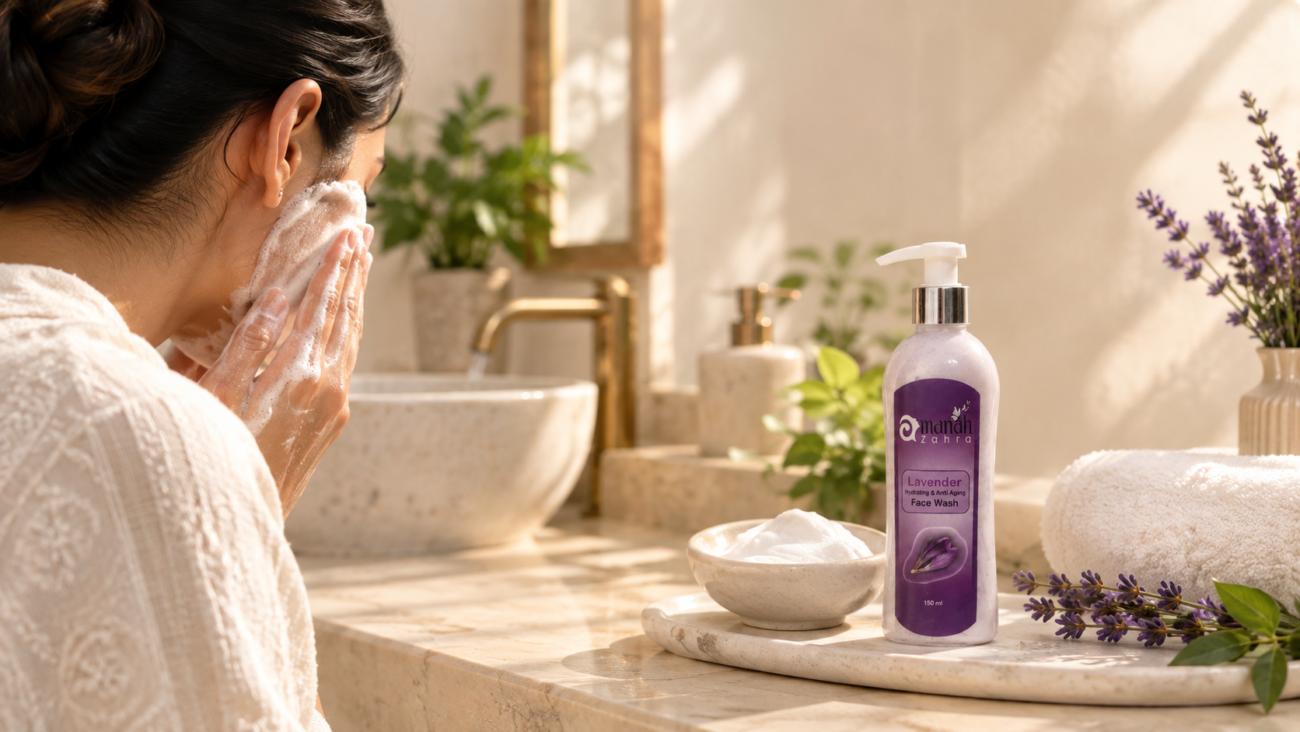
Amanah Zahra Lavender Foaming Face Wash
If you’re looking for a simple oily skin face wash in Pakistan, Amanah Zahra Lavender Foaming Face Wash is one option to consider as part of your everyday cleansing routine.
Its foaming format is particularly suited to the type of cleansing experience many people with oily or combination skin prefer: fresh, lightweight and easy to incorporate into a daily routine.
But I don’t want to tell you that a product is “the best” simply because it belongs to our own brand.
That wouldn’t help you make an informed decision.
Instead, ask yourself how your skin responds to it.
After cleansing, does your skin feel clean without feeling painfully tight?
Does the texture feel comfortable?
Does it fit naturally into your morning and evening routine?
Can you use it consistently without irritation?
Those questions are more meaningful than simply asking whether a bottle says “oil control.”
And if you have persistent acne, severe irritation, painful breakouts or another ongoing skin concern, a cosmetic cleanser may not be enough. The American Academy of Dermatology recommends consulting a board-certified dermatologist when you’re struggling with persistent oily skin, blackheads or acne.
Frequently Asked Questions
What is the best face wash for oily skin in Pakistan?
The best face wash depends on your skin type, sensitivity and specific concerns. For oily skin, dermatologists commonly recommend a gentle cleanser, including gentle foaming formulas, rather than an excessively harsh cleanser.
Which face wash is best for oily and acne-prone skin?
If you have oily skin with acne or clogged pores, ingredients such as salicylic acid may be useful for some people. Mayo Clinic includes salicylic acid among commonly used nonprescription acne ingredients. However, active ingredients can irritate some skin, so your individual tolerance matters.
How many times should I wash oily skin?
Generally, cleanse up to twice a day and after heavy sweating. Washing repeatedly throughout the day can irritate your skin.
Is foaming face wash good for oily skin?
A gentle foaming cleanser can be a good option for oily skin. The American Academy of Dermatology specifically recommends a gentle foaming face wash for people with oily skin while cautioning against harsh formulas.
Should oily skin use moisturizer?
Yes. Oily skin can still become dehydrated or irritated, and dermatologists recommend moisturizing after cleansing. Look for a lightweight, oil-free or noncomedogenic formula when appropriate.
Can washing your face too much reduce oily skin?
Washing more often isn’t necessarily better. Excessive cleansing can irritate the skin, which may make the situation worse. Dermatologists generally recommend cleansing twice daily and after sweating.
Is face wash better than soap for oily skin?
A gentle facial cleanser is generally a better choice for routine facial cleansing than relying on a harsh or irritating soap. The American Academy of Dermatology recommends a gentle, non-abrasive facial cleanser.
When should I see a dermatologist for oily skin?
If oily skin is accompanied by persistent acne, blackheads, significant irritation or another ongoing concern that isn’t improving with a gentle routine, professional advice can help identify the underlying problem.
Your Skin Doesn’t Need a Battle
Having oily skin can be frustrating.
You may feel like you’re constantly checking your forehead, touching your nose, blotting your face, changing your makeup or wondering whether everyone else has somehow figured out skincare while you’re still trying different face washes.
But oily skin isn’t something you need to fight every morning.
It needs balance.
Choose a cleanser that cleans without unnecessarily stripping your skin. Wash your face consistently rather than repeatedly. Don’t scrub aggressively. Don’t skip moisturizer just because your skin is oily. And don’t judge a product only by how “deeply clean” it makes your face feel for the first ten minutes.
Most importantly, give your routine time and pay attention to what your own skin is telling you.
If you’re looking for a simple cleanser to add to that routine, you can explore Amanah Zahra Lavender Foaming Face Wash and decide whether it fits your skin’s needs.
Because the real goal of skincare isn’t to have skin that never produces oil.
It’s to have skin that feels clean, comfortable, cared for—and a routine you can actually stay consistent with.
